Environment
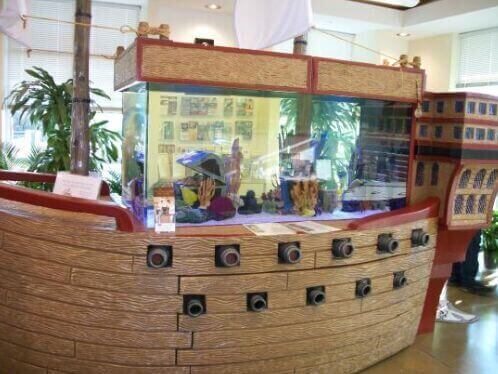
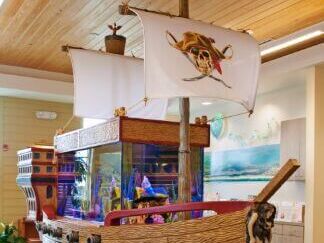
Gulf Themed Fish Tank
Perdido Key’s Visitor Center is home to a 403-gallon pirate ship-themed aquarium, designed by the team of Animal Planet’s hit show, “Tanked.”
This unique attraction includes sea life that can be found in the Gulf of Mexico, showcased in a 6ft long, 3ft wide, and 3ft high tank mounted on the stern of a 14ft long pirate ship, complete with sails and a treasure chest. The exhibit includes educational components for residents and guests of all ages to learn about and appreciate the aquatic life in the Perdido area, as well as an informative feature on the invasive lionfish that are currently impacting our local marine ecosystem.
“Tanked” stars, Wayde King and Brett Raymer, brought the tank to life after the Chamber of Commerce received a promotional grant following the 2010 BP Oil Spill in the Gulf. Their company has produced over-the-top aquariums for fish enthusiasts, using unique methods of display for function and form. They have created custom tanks at restaurants, casinos, churches, museums, zoos, and more all over the world.
Over the years, publicity from the ‘Tanked’ episode has helped to bring many aquarium enthusiasts and tourists back to Perdido Key. As a community prized possession, local businesses in Perdido Key have offered to help take care of the tank’s maintenance through the “Adopt a Fish Program.” Sponsors are able to “adopt” one of the fish in the aquarium and give them a name. They are also recognized and displayed on the tank itself in the visitor center.
Stop in the Perdido Key Visitor Center and Chamber of Commerce located at 15500 Perdido Key Drive to see the Pirate Ship Themed Fish Tank anytime or during one of the regularly scheduled live feedings on Mondays, Wednesdays, and Fridays at 10:30 AM.
Leave No Trace Ordinance
As of 2017, the Leave No Trace ordinance was put into place to protect wildlife such as sea turtles from man-made obstructions. This ordinance provides rules for beachgoers to not leave items such as beach chairs, tents, coolers, towels, etc. to be left on the beach overnight.
Habitat Conservation Plan
Perdido Key offers more than just its breathtaking white sand beaches and the beautiful Gulf of Mexico views. This area is also a vital habitat for nesting sea turtles, various species of shorebirds, and the exclusive home of the Perdido Key Beach Mouse. Though small in size, these mice play a significant role in maintaining the Key’s delicate ecosystem.
To protect the endangered Perdido Key Beach Mouse and other vulnerable wildlife on the Key, Escambia County implemented the Perdido Key Habitat Conservation Plan (HCP). This plan ensures a balance between preserving natural habitats and supporting human activities and development. It outlines essential conservation steps to protect species such as beach mice, sea turtles, and shorebirds, while also safeguarding the very elements that draw visitors to Perdido Key: its pristine white sand beaches and charming, small-town feel.
With guidelines on when and how development can take place, and clearly defined conservation measures, the HCP strikes a balance between environmental protection and economic needs. Any land containing federally designated beach mouse habitat must secure an Authorization of Coverage from the County—commonly referred to as a “Beach Mouse permit”—before any development or land disturbance can proceed.
Barrier Island Light Ordinance
The amended Barrier Island Lighting Ordinance was passed in July 2023 and includes new regulations for Perdido Key properties south of Semmes Rd and updated guidance for Pensacola Beach properties. Lighting requirements outlined in the ordinance are effective immediately for new construction. Existing properties on both islands have until January 1, 2028, to come into compliance.
Perdido Key (South of Semmes Rd): all exterior lighting must utilize wildlife-friendly lighting described below, and no light may be visible outside the development footprint (permanently impacted area consisting of the home/structure, driveways and parking areas, pools, deck, and other man-made features).
Wildlife Lighting Basics
Keep it Low: Fixtures and light sources should be mounted as low as safely possible and utilize the lowest wattage or lumens for the intended purpose.
Keep It Long: Bulbs and fixtures must produce long-wavelength light (<580nm) without the use of filters or lenses. Long-wavelength bulbs appear red or amber. Yellow bug bulbs, color-changing, or coated novelty/party bulbs may appear the correct color but are usually not the correct wavelength.
Keep It Shielded: Light sources should be enclosed in a full cut-off fixture. Appropriate fixtures should shield the light source from being directly visible and prevent light from being broadcast above the horizontal plane.
A number of local and chain retailers carry appropriate fixtures. They may be marketed as Wildlife-Friendly, Sea Turtle-Friendly, or Dark Sky. For a list of certified and approved fixtures, visit the Florida Fish and Wildlife Conservation Commission website here.
Dune Restoration
Local businesses that own property on the beach are responsible for working together to protect the island and beaches by restoring and maintaining the dunes. Important things such as the Sea Oats and thatching procedures are a must for those who own beachfront property.